A funny thing happened in Alice Walker's The Color Purple. While I have trouble reading it sometimes, I can hear it perfectly.
It's novel written mostly in a dialect of the 1930's U.S. South, adhering to a different grammar than those dominant in modern style guides. Deep as the chapters get, the sentences are largely simple. We start the novel in such dire situations that the simplicity increases the empathy for what our narrator is living through. Consider the opening of the second chapter:
"Dear God,
My mama dead. She die screaming and cussing. She scream at me. She cuss at me. I'm. I can't move fast enough. By time I git back from the well, the water be warm. By time I git the ray ready the food be cold. By time I git all the children ready for school it be dinner time. He don't say nothing. He set there by the bed holding her hand and cryin, talking about don't leave me, don't go."
Unless you've read a lot of dire fiction lately, that is a situation that begs for interest and empathy. Interest in what killed her mother, and who the "he" at the end is. Her father? Lover? An older brother?
I've read very little fiction written in this dialect. Even now, every couple of pages I'll get micro-pauses, as I rearrange the words and parse them into the way I typically use language. Sometimes I savor her manner of phrasing, but more often I'm trying to wrap my head around this written syntax.
The funny thing? I can hear it just fine.
On an experiment, I picked up the audiobook. I listened for an hour while driving on errands and never had a single micro-pause for comprehension. Part was the skill of the narrator (my copy is actually read by the author herself), but I've heard people speak this way for most of my life. Out loud, in the mouth of a fluent speaker who can use inflections, it's smoother than poetry to my ears.
Returning to the hardcover, much more of the book reads familiar. It feels like elementary school, as I associate things I've heard growing up with things on the page for the first time. My problem is that while I've heard people speak this way, I've seldom read them write their words down. There's a gross pressure in literature to homogenize and cater to style guides. I recall two professors instructing our class that, even though Mark Twain was very good at writing phonetically and in dialect, we should never try it. It was too confusing to readers.
Well it's too confusing because readers never read it. If you're exposed to different approaches to prose, they become more natural to you. It's the same phenomenon that causes so many amateur critics to deride present tense storytelling. I was on their side as a teenager because I read it so rarely that it came across as stilted - its rareness made me read it that way. As I got older and read more, the uncanny quality went away.
It's also why I'm optimistic on the generation growing up now with tweets and text messages. There is some data to suggest they comprehend standard-grammared testing better kids without phones because they've played with language more, and even if they haven't consciously regarded it, it's unconsciously part of them.
Would challenges like reading The Color Purple, Trainspotting, A Clockwork Orange yield similar benefits? 200 pages in, and I think The Color Purple has equal (if not greater) merit to being taught in high schools as Twain's Adventure of Huckleberry Finn. If you're going to test teens with language outside of their box, it's a book as deep as any other in this paragraph. There's so much to chew... But that should come in a later post.
For now, I am a damned glad that I picked this book. Doubly glad I found Walker's audio.
Showing posts with label Mark Twain. Show all posts
Showing posts with label Mark Twain. Show all posts
Thursday, March 12, 2015


Tuesday, May 28, 2013
Writing for Millions
Everybody wants to be a writer and they should.
Go to any bookstore and read the names. Stephanie Meyer. J.K. Rowling.
The Da Vinci Code Guy. I never hear about these people collecting
garbage or working at Wal-Mart. Writing must be all they have to do,
which means they have to get paid a lot. Now look at the whole
bookstore. That’s a lot of writers, all getting paid millions of
dollars. And it’s so easy to write!
I read a book by Mark Twain once and it
sounded like how people talk. Imagine how easy it was for him to just
write what he’d say. You could talk into a tape recorder for a while and
then pay someone else to type it out for you with the millions of
dollars all writers get paid.
But if you are old fashioned and want to
write by hand, that’s fine. All you have to do is sit and type. You
don’t even have to type that much. Ernest Hemingway once said that if
you write a page a day then you have a 365-page novel at the end of the
year. I’ve never checked his math but assume he’s right because he’s
famous. So if you write about a page, you’re pretty much done for the
day. Thanks to Spell Check you don’t even have to edit anymore.
Also, I never heard of Hemingway doing
anything but writing and getting drunk. Again: writing is a sweet job
since you don’t have to do anything else in your whole life.
I don’t really know how publishing works,
but you get paid in a lot of ways. There’s the advance before you even
write it, then they pay you when you give them the book, and royalties
when they start selling it. Since you get millions every time, that’s
three million for one book. You get even more millions after they make a
movie out of it. A lot of movies are based on books, so I assume all
books become movies that pay you extra and you don’t even have to pay
taxes on that.
It’s not all fun, though. Eventually your
hand cramps up from signing so many autographs and people who are scared
of crowds might get nervous from being stopped and fondled on the
street by their flocks of teen fans. I’m sure it gets annoying
eventually. It’s probably why Hemingway drank. I don’t know because I’ve
never read his books. But what I’m saying is that if you’re not ready
to be rich and really popular, writing might seem overwhelming.
Fortunately book tours and interviews are totally optional since they
pay you the same no matter what.
I’d tell you more but this is almost a full page. So in conclusion, I want to write because it’s easy and pays a lot.
Sunday, February 17, 2013
#NaNoReMo Update #3 – Almost Done
I’m nearly finished with Middlemarch,
and it feels like I’ve been cheating
in my 900-page climb. You see, my grandmother had a serious health issue and I
had to travel to Maryland
to help her. That meant taking four trains, two light rails, a cab, and
spending an additional six hours in lobbies. That also meant ample time to
digest chatty 1800s satire.
 |
| She's doing much better, thank you. |
It’s funny reading satire when you’re being altruistic. 20th
century satire, and thus far, most of 21st century satire hinges on
a cynicism that all but denies the feelings that made me travel last week. Even
Evans/Eliot’s American contemporary, Mark Twain, would never have written a
fictional protagonist thinking or acting as I did, unless it was to mock
whatever petty foibles I exhibited along the way to good intentions. It reminds
that the scalpel is not the only instrument.
Middlemarch is
highly unusual satire, especially set against the modern strains. It’s not
invented to condemn an ideology, religion or social institution, but rather to
rigorously examine why its many characters screw up and hurt each other. Mr.
Bulstrode’s Protestantism is a moral barrier he’s constantly trying to
rationalize around in order to be selfish; Rosamond’s naivety corrodes her
life; Mr. Lydgate’s inability to politic constantly puts his public
works in jeopardy; both the couples of Mary and Fred, and of Dorothea and Will,
almost invent ways to not live happily ever after together because they
overthink and misread too often. She's beaten me to much of wanted to do in Literature by over a hundred years.
Because it’s gentler and not so obsessed with a singular evil, it’s easier for me to take seriously than 1984 or The Daily Show. And I enjoy The Daily Show, but Christ, everything Republicans do is the worst thing in human history. I’m still coming to terms with the phenomenon of comedy performed for applause instead of laughter. It feels like intellectual cancer.
Because it’s gentler and not so obsessed with a singular evil, it’s easier for me to take seriously than 1984 or The Daily Show. And I enjoy The Daily Show, but Christ, everything Republicans do is the worst thing in human history. I’m still coming to terms with the phenomenon of comedy performed for applause instead of laughter. It feels like intellectual cancer.
 |
| Me and the world's largest copy of Middlemarch. |
Too much of modern satire is essential fictional polemic,
identifier an “other guy,” and painting them as dumb and/or evil, with only the
most minimal examinations of why. It shuts down your empathy towards this
“other” in favor of the pleasant outrages of having an enemy. As much as I
admired Catch-22 in my teens, this
ought to be the ground floor of satire, not the heavens.
Middlemarch brazenly scorns hypocrisy, misogyny, ignorance and dogma, but frequently does so with colossal inner working. It makes me wonder if I wouldn’t have preferred 1984 as a book from the perspective of an actual Big Brother on the rise and why he made his awful decisions.
Middlemarch brazenly scorns hypocrisy, misogyny, ignorance and dogma, but frequently does so with colossal inner working. It makes me wonder if I wouldn’t have preferred 1984 as a book from the perspective of an actual Big Brother on the rise and why he made his awful decisions.
It certainly makes me think about where satire could have developed
if Middlemarch had won. It’s not as
gratifying without the obvious audience pandering of modern satire, with
victim-heroes and strawman-villains. I can see why it lost. But I wonder if
this wouldn’t better serve the psyche, to constantly be reminded that every
potential for exterior failure exists within, as a means of progress towards
remedy.
Sunday, May 27, 2012
Fifteen Novels That Stick With Me
Recently on Facebook there’s been a
game to “Name fifteen books you've
read that will always stick with you. List the first fifteen you can
recall in no more than fifteen minutes. ”
It’s morbid of me, but I don’t
believe any book will stick with me forever. I phone my grandfather every night.
With his age, he suffers from dementia and can’t name two books he’s ever read.
The other night he tried to ask how my kids are – and folks, I don’t have any.
However, there are books that stick
around for the long haul. There are books with long-term influence on behavior
or how we write. Just like when the Fifteen
Authors game was in vogue last year, though, I think it’s shameful to not
write some of why these books stick with you. So while I made the list in
fifteen minutes, I spent a few more writing just why they’re listed. Going to use
this noodle while I’ve got it.
Here we go.

1.
J.R.R. Tolkien's The Hobbit
It’s my entry point into the fantastic. The archetypes of Bilbo, Gandalf and Smaug are dug pretty deep into my artistic psyche. The adventure, the convenience of invisibility, the force into so many kinds of bravery and ingenuity – ah, it’s just neat stuff. Also, The Hobbit sticks with me because no matter how I study it, I cannot figure out why as a kid I thought Beorn was black.
It’s my entry point into the fantastic. The archetypes of Bilbo, Gandalf and Smaug are dug pretty deep into my artistic psyche. The adventure, the convenience of invisibility, the force into so many kinds of bravery and ingenuity – ah, it’s just neat stuff. Also, The Hobbit sticks with me because no matter how I study it, I cannot figure out why as a kid I thought Beorn was black.
Guide to the Galaxy
My father was pleased that I liked it, but looked dismayed when I said how good it was the Science Fiction could be fun. No, I didn’t mean “funny.” It was the first SciFi I ever encountered that didn’t take itself so seriously that it failed to entertain, and it remains one of the cleverest novels I’ve ever read. Oftentimes I reflect on it as the end of the spectrum, where all goofy Speculative Fiction ideas race to the edge of visibility.
3. G.K. Chesterton's The Man Who Was Thursday
Part was reading it so long after its publication. Time has certainly helped the satirical novel’s opinions age and become more pliable than originally intended. That initial reading made it a damning satire, but also a damnably effective satire of satire itself. Religion is defended, but also excoriated. Anarchism is embraced, but by morons. Especially after Hitchhiker’s Guide, it’s a stirring reminder not to leave any side standing in humor.
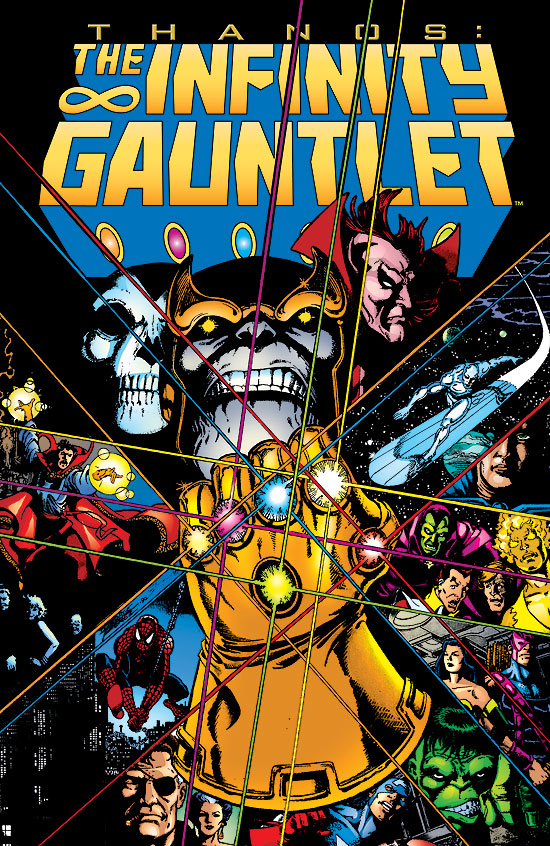
4. Jim Starlin's Infinity Gauntlet
At least one comic book would be on here. At several junctures in my ADD-addled childhood, they got me to sit down and read at all. This one introduces Thanos, probably my all-time favorite villain. It’s rare that a god doubles as a mad scientist, and rarer that either of those is a hopeless, cuckolded romantic. There’s a Mary Sue quality to his rise to power and eradicating so many iconic heroes, but there’s also a Hamlet quality to how he loses it. And who doesn’t want an Infinity Gauntlet?

5. Mark Twain's The Adventures of Tom Sawyer
One of the first novels I ever re-read, and one that I re-read as a bedridden teenager. Divorced from social interaction, I misinterpreted Tom’s romantic values, which Twain meant to be skewering satire, for earnest instruction and tried to live by them when I started walking again. I got made fun of a lot. The comedy of errors I lived out for a few years as I weeded this stuff out of my head has always stuck with me.

6. Mark Twain's The Diaries of Adam and Eve
Hard not to go back to Twain. I read this one later in life, in a collected edition. It’s disappointingly funny – disappointing in that very little comedy can hereafter be written about the tensions between the sexes without seeming pat. That he disarmed with anarchic humor to mount some deep emotional catharsis about attachment and loss has helped it stick around in my head.

7. The Book of Job
I actually got offended when a friend told me she wasn’t surprised this was my favorite part of The Bible. Sure, life has kneecapped me a few times, but come on! Yet, it is one of humanity’s greatest hits. It was also one of the biggest hype-bubbles my non-academic ever burst, as it’s not about blind devotion to God, but about how people rush into inaccurate judgment of each other, especially in bad times. It’s a literary and theological kick in the ass that most people need twice-daily.
8. Stephen King's Needful Things
The first of the King novels stuck with me, following a familiar theme in his work. This time it was Mr. Gaunt as the creeping, supernatural thing in civil guise, joining, linking and sinking his teeth into the way we live. One of the sickest things Horror can do is point out how ignorant quotidian life makes us to dangers. Making those dangers abstract or fantastical can deepen things.
9. Stephen King's Desperation
My favorite of the King novels. There is guts, of course, with the blatant relationship to the Bachman book The Regulators, and that stands out for humor. But there’s also god against god – the hands-on against the hands-off, both tormenting us mortals in some ways, sure, but the difference between them is so much more provocative and thoughtful than I’ve seen in any modern novel that grapples with gods. It’s lucky that it all plays out over some crazy set-pieces: the heart-wrenching story of the boy hit by the car, and the family that gets locked up by a mad police officer, and that poor bastard who gets eaten in the bathroom. All that scenery stuck with me too, because it showed the benefits of delivering the goods while feeling out your themes.
10. John Steinbeck's East of Eden
I wonder how many people list this one, of all the Steinbeck books? I’d guess Of Mice and Men and Grapes of Wrath lap it. And those are compelling works, but the primal explosion of the Cain and Abel archetypes is so interesting. It’s almost a blueprint for how you should appropriate someone else’s work, with homage and obvious familiarity, but not leaning on it so heavily that your authenticity disappears. This whole novel is authentic Steinbeck in its tragic psychology.
If we talk about bleak fiction, chances are I’ll think of this. As a general and poor rule, I dislike bleak fiction, for especially in the Literary variety, it leads to masturbatory and uninteresting work. A Day in the Life of Ivan Denisovich is neither of those things, nor is it about heroism or a great escape, nor is it so mired in social commentary that it chokes on opinion like 1984. It’s just a day in a miserable life that too many people were forced to live, and through Denisovich’s experience in the gulag, is a veritable model for how not to break under the weight.
12. Shirley Jackson's We Have Always Lived in the Castle
Perhaps the finest book of dialogue I’ve ever read. I still can’t pull of those voices – the plethora that doesn’t need to be marked or divided, each of which is so readily identifiable by vocabulary, topic and coherence. It is brightly and darkly funny, sad and hopeful, and damn it, that ending is better than anything I’d expected.
13. Gail Simone's Deadpool
One more comic book. Like M*A*S*H and Lupin the 3rd, it sticks with me because she assembled such an endearing cast with so many opportunities for modular dynamics. I could read about the fake cowgirl and the crappy hitman and the failed superhero who wears a tuxedo over his costume forever. A shame sales didn’t hold out for this or Agent X. I feel good when I read her missing that cast, too.
I’d wanted a book like this for years. It’s a novel about a nation at unrest with its past and its future, where virtually everyone is guilty. The citizens, the voters, Europeans, natives of all colors, rising political figures, judges – and rather than assaulting them for their failures, it’s compassionate in its descriptions of the ways they can fail. There’s optimism in some of it, obviously, but the holistic approach to why problems are so endemic is too rare.
In a little corner of John
Wiswell’s mind is the desire that every novel actually be this: dudes beating
the crap out of each other until the biggest dudes butt heads, and then the end.
It’s gorgeous in every translation I’ve ever read, and the theme of the rest of
the world’s experiences being woven in by metaphor to express what war is
fought for is among the greatest feats in literary history. But I know me. Ajax is such a hoss.
So there are my fifteen. Any surprises for you? If you decide to play this game and write up why the books stick with you, please link me up in the comments. I'm curious why fiction sticks with you.
Subscribe to:
Posts (Atom)
 Counter est. March 2, 2008