I’m nearly finished with Middlemarch,
and it feels like I’ve been cheating
in my 900-page climb. You see, my grandmother had a serious health issue and I
had to travel to Maryland
to help her. That meant taking four trains, two light rails, a cab, and
spending an additional six hours in lobbies. That also meant ample time to
digest chatty 1800s satire.
 |
| She's doing much better, thank you. |
It’s funny reading satire when you’re being altruistic. 20th
century satire, and thus far, most of 21st century satire hinges on
a cynicism that all but denies the feelings that made me travel last week. Even
Evans/Eliot’s American contemporary, Mark Twain, would never have written a
fictional protagonist thinking or acting as I did, unless it was to mock
whatever petty foibles I exhibited along the way to good intentions. It reminds
that the scalpel is not the only instrument.
Middlemarch is
highly unusual satire, especially set against the modern strains. It’s not
invented to condemn an ideology, religion or social institution, but rather to
rigorously examine why its many characters screw up and hurt each other. Mr.
Bulstrode’s Protestantism is a moral barrier he’s constantly trying to
rationalize around in order to be selfish; Rosamond’s naivety corrodes her
life; Mr. Lydgate’s inability to politic constantly puts his public
works in jeopardy; both the couples of Mary and Fred, and of Dorothea and Will,
almost invent ways to not live happily ever after together because they
overthink and misread too often. She's beaten me to much of wanted to do in Literature by over a hundred years.
Because it’s gentler and not so obsessed with a singular evil,
it’s easier for me to take seriously than 1984
or The Daily Show. And I enjoy The Daily Show, but Christ, everything
Republicans do is the worst thing in human history. I’m still coming to terms
with the phenomenon of comedy performed for applause instead of
laughter. It feels like intellectual cancer.
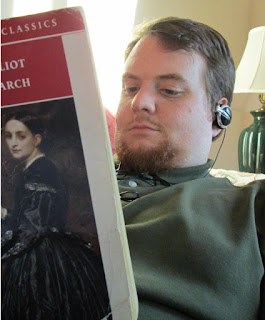 |
| Me and the world's largest copy of Middlemarch. |
Too much of modern satire is essential fictional polemic,
identifier an “other guy,” and painting them as dumb and/or evil, with only the
most minimal examinations of why. It shuts down your empathy towards this
“other” in favor of the pleasant outrages of having an enemy. As much as I
admired Catch-22 in my teens, this
ought to be the ground floor of satire, not the heavens.
Middlemarch brazenly scorns hypocrisy, misogyny, ignorance and dogma,
but frequently does so with colossal inner working. It makes me wonder if I
wouldn’t have preferred 1984 as a
book from the perspective of an actual Big Brother on the rise and why he made his awful
decisions.
It certainly makes me think about where satire could have developed
if Middlemarch had won. It’s not as
gratifying without the obvious audience pandering of modern satire, with
victim-heroes and strawman-villains. I can see why it lost. But I wonder if
this wouldn’t better serve the psyche, to constantly be reminded that every
potential for exterior failure exists within, as a means of progress towards
remedy.


 Counter est. March 2, 2008