Sunday, May 27, 2012

Fifteen Novels That Stick With Me


Recently on Facebook there’s been a game to “Name fifteen books you've read that will always stick with you.  List the first fifteen you can recall in no more than fifteen minutes. ”

It’s morbid of me, but I don’t believe any book will stick with me forever. I phone my grandfather every night. With his age, he suffers from dementia and can’t name two books he’s ever read. The other night he tried to ask how my kids are – and folks, I don’t have any.

However, there are books that stick around for the long haul. There are books with long-term influence on behavior or how we write. Just like when the Fifteen Authors game was in vogue last year, though, I think it’s shameful to not write some of why these books stick with you. So while I made the list in fifteen minutes, I spent a few more writing just why they’re listed. Going to use this noodle while I’ve got it.

Here we go.

1. J.R.R. Tolkien's The Hobbit
It’s my entry point into the fantastic. The archetypes of Bilbo, Gandalf and Smaug are dug pretty deep into my artistic psyche. The adventure, the convenience of invisibility, the force into so many kinds of bravery and ingenuity – ah, it’s just neat stuff. Also, The Hobbit sticks with me because no matter how I study it, I cannot figure out why as a kid I thought Beorn was black.


2. Douglas Adams's Hitchhiker's
Guide to the Galaxy

My father was pleased that I liked it, but looked dismayed when I said how good it was the Science Fiction could be fun. No, I didn’t mean “funny.” It was the first SciFi I ever encountered that didn’t take itself so seriously that it failed to entertain, and it remains one of the cleverest novels I’ve ever read. Oftentimes I reflect on it as the end of the spectrum, where all goofy Speculative Fiction ideas race to the edge of visibility.


3. G.K. Chesterton's The Man Who Was
Thursday

Part was reading it so long after its publication. Time has certainly helped the satirical novel’s opinions age and become more pliable than originally intended. That initial reading made it a damning satire, but also a damnably effective satire of satire itself. Religion is defended, but also excoriated. Anarchism is embraced, but by morons. Especially after Hitchhiker’s Guide, it’s a stirring reminder not to leave any side standing in humor.
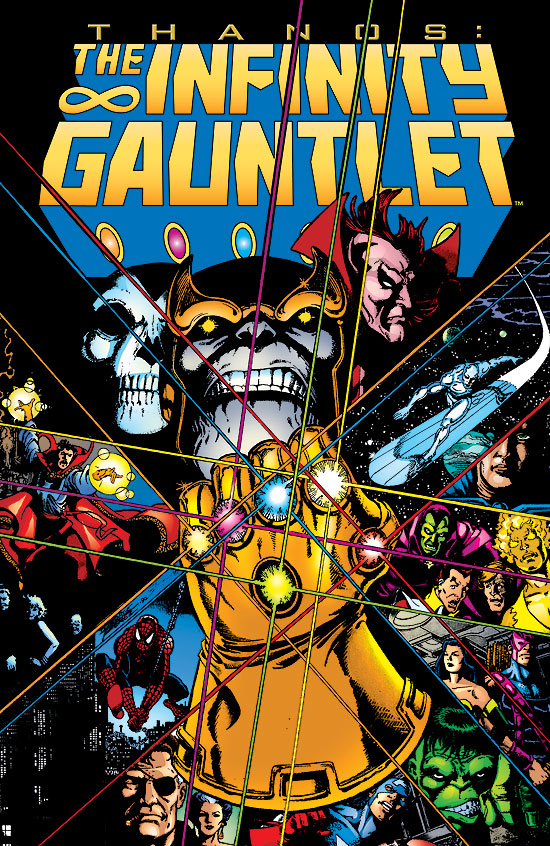


4. Jim Starlin's Infinity Gauntlet

At least one comic book would be on here. At several junctures in my ADD-addled childhood, they got me to sit down and read at all. This one introduces Thanos, probably my all-time favorite villain. It’s rare that a god doubles as a mad scientist, and rarer that either of those is a hopeless, cuckolded romantic. There’s a Mary Sue quality to his rise to power and eradicating so many iconic heroes, but there’s also a Hamlet quality to how he loses it. And who doesn’t want an Infinity Gauntlet?


5. Mark Twain's The Adventures of Tom Sawyer


One of the first novels I ever re-read, and one that I re-read as a bedridden teenager. Divorced from social interaction, I misinterpreted Tom’s romantic values, which Twain meant to be skewering satire, for earnest instruction and tried to live by them when I started walking again. I got made fun of a lot. The comedy of errors I lived out for a few years as I weeded this stuff out of my head has always stuck with me.


6. Mark Twain's The Diaries of Adam and Eve

Hard not to go back to Twain. I read this one later in life, in a collected edition. It’s disappointingly funny – disappointing in that very little comedy can hereafter be written about the tensions between the sexes without seeming pat. That he disarmed with anarchic humor to mount some deep emotional catharsis about attachment and loss has helped it stick around in my head.


7. The Book of Job

I actually got offended when a friend told me she wasn’t surprised this was my favorite part of The Bible. Sure, life has kneecapped me a few times, but come on! Yet, it is one of humanity’s greatest hits. It was also one of the biggest hype-bubbles my non-academic ever burst, as it’s not about blind devotion to God, but about how people rush into inaccurate judgment of each other, especially in bad times. It’s a literary and theological kick in the ass that most people need twice-daily.


8. Stephen King's Needful Things


The first of the King novels stuck with me, following a familiar theme in his work. This time it was Mr. Gaunt as the creeping, supernatural thing in civil guise, joining, linking and sinking his teeth into the way we live. One of the sickest things Horror can do is point out how ignorant quotidian life makes us to dangers. Making those dangers abstract or fantastical can deepen things.


9. Stephen King's Desperation

My favorite of the King novels. There is guts, of course, with the blatant relationship to the Bachman book The Regulators, and that stands out for humor. But there’s also god against god – the hands-on against the hands-off, both tormenting us mortals in some ways, sure, but the difference between them is so much more provocative and thoughtful than I’ve seen in any modern novel that grapples with gods. It’s lucky that it all plays out over some crazy set-pieces: the heart-wrenching story of the boy hit by the car, and the family that gets locked up by a mad police officer, and that poor bastard who gets eaten in the bathroom. All that scenery stuck with me too, because it showed the benefits of delivering the goods while feeling out your themes.


10. John Steinbeck's East of Eden
I wonder how many people list this one, of all the Steinbeck books? I’d guess Of Mice and Men and Grapes of Wrath lap it. And those are compelling works, but the primal explosion of the Cain and Abel archetypes is so interesting. It’s almost a blueprint for how you should appropriate someone else’s work, with homage and obvious familiarity, but not leaning on it so heavily that your authenticity disappears. This whole novel is authentic Steinbeck in its tragic psychology.


11. Aleksandhr Solzhenisyn's One Day in the Life of Ivan Denisovich

If we talk about bleak fiction, chances are I’ll think of this. As a general and poor rule, I dislike bleak fiction, for especially in the Literary variety, it leads to masturbatory and uninteresting work. A Day in the Life of Ivan Denisovich is neither of those things, nor is it about heroism or a great escape, nor is it so mired in social commentary that it chokes on opinion like 1984. It’s just a day in a miserable life that too many people were forced to live, and through Denisovich’s experience in the gulag, is a veritable model for how not to break under the weight.


12. Shirley Jackson's We Have Always Lived in the Castle


Perhaps the finest book of dialogue I’ve ever read. I still can’t pull of those voices – the plethora that doesn’t need to be marked or divided, each of which is so readily identifiable by vocabulary, topic and coherence. It is brightly and darkly funny, sad and hopeful, and damn it, that ending is better than anything I’d expected.


13. Gail Simone's Deadpool

One more comic book. Like M*A*S*H and Lupin the 3rd, it sticks with me because she assembled such an endearing cast with so many opportunities for modular dynamics. I could read about the fake cowgirl and the crappy hitman and the failed superhero who wears a tuxedo over his costume forever. A shame sales didn’t hold out for this or Agent X. I feel good when I read her missing that cast, too.


14. Alan Paton's Cry the Beloved Country

I’d wanted a book like this for years. It’s a novel about a nation at unrest with its past and its future, where virtually everyone is guilty. The citizens, the voters, Europeans, natives of all colors, rising political figures, judges – and rather than assaulting them for their failures, it’s compassionate in its descriptions of the ways they can fail. There’s optimism in some of it, obviously, but the holistic approach to why problems are so endemic is too rare.


15. Homer's Iliad
In a little corner of John Wiswell’s mind is the desire that every novel actually be this: dudes beating the crap out of each other until the biggest dudes butt heads, and then the end. It’s gorgeous in every translation I’ve ever read, and the theme of the rest of the world’s experiences being woven in by metaphor to express what war is fought for is among the greatest feats in literary history. But I know me. Ajax is such a hoss.


So there are my fifteen. Any surprises for you? If you decide to play this game and write up why the books stick with you, please link me up in the comments. I'm curious why fiction sticks with you.

Saturday, May 26, 2012

Friday, May 25, 2012

Bathroom Monologue: Frankenstein's Monsters

When they heard what Frankenstein was up to the town put up quite a ruckus. Anyone without a flashlight (and there were quite a few, as they hadn’t been invented yet) lit a stick on fire and called it a torch. Dozens of howling fire-bearers in jockey shorts hustled up to the gates of Castle Frankenstein and beat on the doors until the Doctor showed his face.

“There is no—” he started to lie, but was cut off by the town Point Guard.

“Germany hasn’t won the gold medal in basketball in years and we hear you’ve got a seven-foot undead countryman up there. Can he come out and play?”

“You can’t…” The Doctor paused. “Wait, you want to what?”

“We want to see if he can slam dunk. We’ve never had a player who could reach the net without a step-ladder, and that’s illegal in the Olympics.”

Dr. Frankenstein kept most of his body braced behind the door, but poked his face out to stare at the jockey-shorted rioters.

“You don’t want to kill him?”

“Listen,” said the Point Guard, “we aren’t very tall and we don’t bathe often, but we’re very technically sound.”

The Doctor put a hand on his hip. “I didn’t know there was a local basketball team.”

“Yes, advertising is difficult without moveable type. We’re buying a machine on lay-away, but all we have right now is the letter A, and eventually get bored of stamping everything with the same vowel.”

“So you don’t want to kill my creation?”

“Heavens no! We want to kill that insipid American team that wins all the time. President James Monroe drives the lane like it’s his doctrine. It’s terribly frustrating. That’s why we need your giant. Let’s see him bowl over a man stitched together from the best German bodies available.”

The Doctor laughed nervously. “Here I thought you were coming to kill the Monster…”

“Monster?” the Point Guard exclaimed and look back at the crowd. Their faces lit up in unison.

Another in the crowd cried, “That’s brilliant! We needed a team name.”

The Point Guard thrust his arm in the air. “Here’s to Frankenstein’s Monsters!”

Then the jockey-shorted peasants began pumping their torches and chanting, “Mon-sters! Mon-sters!” Except in German.

Thursday, May 24, 2012

Crippling Doubts in the Rough Draft


On Monday I began my next novel, The Last House in the Sky. During my previous novel I tried to stay as open as possible about how I worked, whether it was stumbling, marking what would need changing later, or what I was proud of that day. I was surprised by the warm public reception, particularly to the post breaking down how much I wrote and when.

Because I believe one person’s transparency can help another person’s process, I wanted to list the anxieties I had during that day. There were a lot – so many that I opened a Notepad file to jot them down. It became funny to compare them against each other over time. Anxiety kills more worthwhile projects than anything else I know, and often it’s a process of learning what to disregard.

It started with the two things I feel on most projects, and have long since come to suppress because neither has ever been right.

1. The novel won’t be long enough.
-I haven’t planned enough events! A novel needs way more to happen.
-The plot points I have planned will all go too short. If each only winds up needing a few pages, this sucker won’t even make it to a novella, and novellas are hard to sell.

It’s interesting to note that within minutes of this, I felt …

2. The novel will be way too long.
-I only think the plot is scrawny. Some of these events will balloon unexpectedly to ten thousand words and I’ll wind up with a novel that’s unsellably huge. Half the stories I’ve ever written had plot points that exploded. Why am I not prepared for it to happen here?
-I know it’s only a skeleton with the first few chapters coming up right now, but what things am I willing to cut?

3. These jokes are only funny to me.
-The character quirks will offend somebody. If not at Chambers showing up shamelessly naked, then at the other guy endlessly courting a lesbian.
-The jokes are too contextual to quote. How can the novel go viral if the quips can’t be tweeted? Why does all the humor have to build up?
-I’m a horrible writer and everyone will misread the tone as serious and find no whimsy in land-squid chasing a rust Volkswagen Beetle across a desert.
-Nobody else wants to read about a backstabbing decapitated gremlin or land-squid chasing cars. I’m simply too deranged to market.

4. There’s no hook!
-I mean, you don’t know the whole plot on page one. Who reads books that don’t spill the plot on page one?
-Okay, everyone does, but there’s nothing interesting on page one. Only a guy in a tuxedo and sword wading through a monster-infested fog to turn himself in at a prison. I need to get to the premise faster.

5. There are too many hooks!
-The monsters in the fog, and all the criminals turning themselves in for no apparent reason, and the guards at the jail plainly not being real guards, and The Boss being missing, and why they drew signs in orange paint… the reader will be too confused. Sensory overload. I can envision them putting the book back on the shelf.

As I rounded out the second chapter that afternoon, I had ample opportunities to reflect on the opening. Oh, the opening…

6. The opening…
-…is too straightforward. I need more exposition.
-…has too much dialogue containing exposition.
-…is too nebulous and people will get confused and give up.
-…takes too long to reveal what they’re all planning.
-…has so many moving parts that only a couple will have punch, and readers won’t understand any of the others when they come to fruition.

I hope you realize there is not one item above that is worth stopping over. Once you have experience, you know when to course-correct and experiment. Otherwise, these are the kinds of momentary doubts that exist solely to annoy the writer. I came in with a good guideline, I bolded things that weren’t working to massage later, and post-completion editing will catch any stylistic or structural problems that I don’t alter on the fly.

Do any of those doubts sound familiar to you?

Wednesday, May 23, 2012

Bathroom Monologue: Evil is Back


He sprang from the disembodied womb of a yeti, and was weaned on the flesh of a million virgins. Before he could walk, he had slain his first crusaders. Before he could run, he had slain the first-born of all known kings. His footsteps make seas boil, and his wings send up such a hurricane of dust that generations forget what the sun looked like. Beneath each of his sundry wings is sheltered an army of nightmares and fel shadows. He is the drowner of whales, the defiler of angels, and no matter how many heroes have risen and struck him down, he has always returned when the publisher needed a sequel.

Tuesday, May 22, 2012

Consumed Episode 5: Cabin in the Woods, Fez and The Warded Man


Consumed Episode 5 is out today! It’s a free MP3 download with some of the farthest-reaching discussions on any of our podcasts yet.

For me, the most interesting conversation came from Peter V. Brett's The Warded Man. It's a rare Fantasy novel that hits the ground running, in its case opening with a nocturnal demon attack. It led me to ask my co-hosts why Speculative Fiction prose usually starts out so slow, low-action and thick with exposition. We considered George R.R. Martin, N.K. Jemisin, C.S. Lewis, J.R.R. Tolkien, and J.K. Rowling, and explored why films and videogames in the same genres usually start off much faster. We’d love your thoughts on this topic in the Comments over there.

We also discussed the mind-bending puzzle game, Fez, and why so many people either adore it or walk away from it (us podcasters were split on the love it/leave it). We wrapped up with Cabin in the Woods, the meta-Horror film which seems destined to be overlooked this year. While the conversation eventually devolves into self-censorship to avoid spoilers, I recommend listening just to hear me embarrass myself trying to describe Anna Hutchinson making out with a stuffed wolf head, and whether we can talk actor-host Nat Sylva into doing the same.

You can download the episode and leave feedback right through this link.

Monday, May 21, 2012

Bathroom Monologue: He Walked in on the Wrong Reality


"I expected a cabaret. A cabaret full of hookers. Or, a castle, and you’d be Dr. Doom. I could definitely see you programming a virtual reality where you wore a cape. But this…?

"What is with all the pre-teens, dude?

"A virtual reality all-girls Junior High? What? You come home from work to two-hundred kids in school uniforms? And why are you bald in your fantasy? Never would I have imagined you to program yourself as a balding, middle-aged principal. You’re, like, forty imaginary years older than them. That’s so creepy I want to avoid having kids just so you can’t go near them.

"That all these relationships seem platonic and chaste and adorable? I think that’s actually creepier than if you were a pedophile. If you were a pedo, I don’t know, I’ve been on 4chan. I’ve seen that. I can deal with that. What crazy fetish makes you tie a little virtual girl’s shoes and settle playground fights? What the fuck was with that kid crying on your shoulder about a B- for half an hour? What the fuck hobby is this?

"Some people watch trains. Some people collect doll houses. Is this like doll houses? Is this your version of little porcelain shoes and balsa dining tables? Please tell me that’s what this is, because if this has a seedy dimension, I think I’ll have an aneurysm.

"Please let me log back out to the real world. I promise I will never look in here again."

Sunday, May 20, 2012

The Brutal 2,000-Word Day

Last week the New York Times ran an article suggesting that authors only writing one book a year is slacking. Nowadays indy authors have a better chance of building an audience if they write multiple books a year, and big publishing houses view additional output as useful promotion. To write less might just mean we’re lazy. Lisa Scottoline has received particular bile on social networks for being described as struggling to write 2,000 words per day.


How do I write so much per year? Bubble baths.
 Twitter whipped out the ballistics-grade snark. Writing is easy! Anyone can bang out a thousand words in an hour. That’s just a long blog post. I didn’t work that hard on NaNoWriMo! Get back into the salt mines, authors!

What rankled me was the number of mediocre writers espousing this condescension. Many were hacks whose e-books aren’t worth 99-cents and whose blog posts run over 2,000 words because they don’t know how to edit. Of course it’s easy to fluff up word count if you don’t care about craft. 

It rankled worse with rush-pundits who actually show raw talent that, with the time and reflection they insist you eschew, could develop into something great. What they’d learn from experience will be stifled by the positive feedback loop of rushing adequate chunks of text to market. Traditional publishing has nearly killed the Max Perkins style that gave us Fitzgerald, Wolfe and Hemingway. God save us if the next wave of publishing kills taking your time.


Slacker! He'll never go anywhere.


John Scalzi was particularly level-headed. He advised folks to calm down and recognize that everyone has his or her own writing speed. And he was right. Many of us grew up on Stephen King, who seems to write at the speed of sound. Amanda Hocking and Seanan McGuire do multiple novels per year, and Jim Butcher has at least one door stopper a year. Meanwhile Jo Walton and Justin Cronin take about two years to release one book a-piece, and Patrick Rothfuss and George R.R. Martin can run even longer.

In a better world those authors who were at ease with promotion and speedy production would use their platforms to help the slower. I stump for talented authors of all paces routinely and have been lucky to find like-minded folks. But while Scalzi was correct, I still ran hot.

Last night Jo Walton’s Among Others took the Nebula Award for Best Novel, and it took her at least two years to release it. This should remind us of great works that make that schedule seem liberal: it took Harper Lee decades to give us To Kill a Mockingbird, and just as long for Larry McMurtry to produce Lonesome Dove. Imagine an editor yelling at J.R.R. Tolkien to meet his deadline on Lord of the Rings. Imagine the next genre luminary getting the same browbeating while she tries to puzzle out world-building we haven't conceived of yet.

Or imagine some blowhard on Twitter screeching that she's not working hard enough.


Among Others by Jo Walton
A great work, but also one of privilege.

The self-publishing world, and particularly the Locke-and-Hocking world of cranking out as many e-books as possible, is not delivering such works. The best of these books I've read were passably entertaining and couldn't strive for more in their production cycles. In a market where a large catalog and frequent releases are your best shots at a career, it really can’t, and if you want to make a living, that two-year cycle of a Jo Walton or Justin Cronin seems implausible barring a very lucky hit. And when Amanda Hocking got that hit? It was having her sizable catalog that helped her become a millionaire.

Since I see something like this self-publishing model dominating the industry in a few years, this is disturbing for the future of an art form. We can’t stop the price cycling that Amazon, Apple and the Big Six have steered us toward. We can alter how we interact and help each other. That novel Harper Lee spent so long on owed a debt to Truman Capote’s assistance. Those who succeed in the speedy new market can help not just teach and critique, but to promote talents that have different paces.

The rebuttal is that the market doesn’t want great literature. It wants twists and thrills and titillation, and little else. It’s too dumb to recognize exposition and formula, and authors are fooling themselves for caring about more than dollars. This "market" would become a race to the bottom of both price and ambition, allowing The Novel to survive a few more years by imitating reality television’s innovations. If the future of publishing really is who can write the most blood-and-smut the fastest, then I might as well kill myself now.

You may notice I haven’t committed suicide today. Like yesterday and last week and last month, I’m taking exactly as long as my novels require. I will not sell you something that is unworthy of your time, regardless of whether it’s through HarperCollins, Tor or Kindle Direct Publishing. And when I read something great, hailing from any country, creed or composition cycle, I’ll share it. If the next Lord of the Rings emerges from self-publishing, I’ll grin through my humiliation and help its author out. Whoever it is will probably need the help.

Saturday, May 19, 2012

Bathroom Monologue: Mancers, OR, An Order of Wizards


Necromancer, Pyromancer, Geomancer – these get too much attention, as though they make up the whole of magic. There is a substantial industry, a veritable economic biosphere, supporting the flashy varieties of magicians. For instance, from whence do all these old fogeys get their durable robes? Macraméncers. It’s difficult work, knitting fabric that has comparable Armor Ratings to chainmail. And every generation sees more wizards, despite all of them being bearded and wrinkled shut-ins. How do they manage to populate so? Romancers, the aetherial dating service for people who hold wands more than hands. Surely you’ve encountered that tragic necromancer who seeks to bring his lady love back from the grave, yet zombie hugs are seldom. There’s even a wizard for that least common form of couples counseling: necroromancers. These, and every other stripe of magical servant you can find in The Yellowed Pages.

Friday, May 18, 2012

Bathroom Monologue: Maybe They've Stopped Using Stamps

He means to get up early the next day. For a sleepy instant he thinks he’s woken even earlier then expected – and then his eyes adjust to the hands of the clock.

Fucking ten thirty, he means to yell.

He tries to yell it.

He claps his ears. Gets out of the rickety bed and pads across loose floorboards. He can’t hear a thing, not even the ambient usuals.

A drowsy fog still slowing his wits, he decides this must be going around. Twenty-four-hour deafness. You eat enough processed lunchmeat and that probably happens to you. Everything sprouts new side effects all the time. Or maybe he’s sleepy and his ears haven’t woken up! But this can’t be permanent because he’s got bills due and a postman to beat.

He signs the last check, the alimony one, certain to bounce. He stuffs the last envelope and seals it with his last stamp. In a few years, they won’t even use these anymore. The electric company will own your bank account and know there’s nothing in there long in advance.

He pulls on jeans and a plaid button-down. He buttons it halfway down and skips the shoes because pants-and-most-of-a-shirt is exactly how much he cares about the neighbors. No thigh, no belly, but no more decency than that because they all sided with Zelda in the divorce.

He bursts through the screen door and runs for the mailbox. He is halfway there before he recognizes that it is now a pit in the ground.

It was not a pit in the ground yesterday.

The road is now a series of smoking pits. He visits where his mailbox should be and turns down Cherrywood. Everything below the hill is one gaping crater.

He swears. He doesn’t hear it. He swaps his ear with a pinky and finds blood.

He looks around. The neighbors’ houses are all replaced by smoking craters, so nobody else heard him swear either.

Just before reason sets in, he turns up Cherrywood and checks the other direction. It is another gigantic blast zone. He can’t even see the bottoms of those craters. King Kong could be hiding in there. King Kong may have been responsible for all this.

He cannot beat the mailman today. There is no mailman to beat. There is a good chance they have stopped using stamps by now.

Reason sets in. A hand fists over his scalp and tears out a clump of hair. He runs screaming to the porch, deaf to his own terror. A foot plants inside a bucket and drags it with him halfway down the hall.

He picks up the phone. There’s no dial tone.

Of course there’s no dial tone, he actually tries to say.

The world is over, plus you’re deaf. He realizes enough not to say that.

Can he get Disability Pay? That might cover alimony.

He looks in the mirror. Blood trickles from his earlobes. Did whatever blew up the world pop his eardrums and then concuss him back to sleep? Is that possible? Would Disability cover that?

Wait, he watches himself mouth. You don’t owe alimony anymore. Zelda’s dead. Plus, probably everybody at the Social Security Office.

He mourns the Social Security Office workers on his way through the kitchen-cum-living room. There were probably some charitable people working there and it’s sad that they died. Kind of sad. About as sad as he can be about strangers dying without CNN describing them.

He tries to switch on the TV. It won’t go.

Of course it won’t go, he thinks he says. The world’s over. Electricity has ended.

He stubs his toe against the bookshelf. The one thing Zelda left; she was a movie girl, he was a reader. He growls mutely and knees the ugly oaken thing. So wide that it always jutted just a little into the hall and caught him on the way around, even when one foot was lodged in a bucket.

His bookshelf doesn’t run on electricity. As he pulls off the bucket, he jostles against the shelves and a couple hardcovers shake free, plopping open on the floor. He collects them, shaking his head. He always did buy books twice as fast as he read them. He hasn’t done nearly any of them. Shirley Jackson: Novels and Short Stories. Les Miserables. Man, you could bludgeon a guy to death with The Brothers Karamazov. Plus it’s Russian, so somebody probably does get bludgeoned to death in it.

He picks up The Brothers Karamazov. He brings his bills for bookmarks, and in case the mailman has survived the end times. He plops down on the edge of his filthy porch, resting his back against his filthy but trusty plastic bucket.

He reads out loud, not because he can hear it, but because Zelda hated when he did that.

Thursday, May 17, 2012

Bathroom Monologue: Unbelievable Girl


God sent her to harass me. Girls that pretty don’t laugh at my jokes. I mean, yes, I could have met a girl who looked like her at the AIDS Quilt. People of every shape, even mine, do that. But girls that pretty do not compliment my eyes. They don’t look at them; even I’d never noticed my freaking eyes before. And without the deliberate and cruel intervention of a divine entity, I couldn’t possibly have run into her later that night at the second-run theater for Cabin in the Woods, or that weekend at Tom Waits. Those things do not triangulate on their own.

The long, stringy hair that keeps getting stuck between my teeth. Jesus, everything about her was designed to mess with me. Every morning I have to come up with some dumb explanation for how that happened, even though I was asleep, and she knows it. Every morning she looks at me, preemptively bemused with the apology to come. Nobody would do that unless God made them to mess with my head.

She never has emergencies; she never needs to go to the hospital in the middle of the night. She never even needs help reaching anything; she reaches things for me. She never misses work, and finds all the good music long before I do. I’ve never introduced her to one band she didn’t nod along to and say, “Oh yeah, them!”

When she needs me, it’s extracurricular. Like she couldn’t balance an account if she wanted. Half the time I think she makes up her fear of driving in the rain so I’ll feel important. I keep glancing at the passenger seat, hoping to catch her with her guard down and not cringing at thunder, and at the same time, I hope I never catch her doing that. Maybe she’s not a trick? It’s a nice thing to believe.

I want to believe in her. That’s the worst part. That someone who’s taller, and smarter, and healthier, and just better than me would actually want me. But I don’t have the faith. God, am I going to kill this relationship by waiting for it to disappear?

Wednesday, May 16, 2012

Bathroom Monologue: What if he doesn’t have a secret identity?


"What if he doesn’t have a secret identity?

"I mean, I’m familiar with the patterns. These holes in his schedule, of fifteen minutes or two hours or seemingly random nights when he doesn’t stop crimes. His activity is localized on this city, and radiates outward from there. There’s video of him seeming distracted. I get where the double-life theory comes from.

"But as best as I understand it, he’s a fucking invincible alien. He owns a private ice palace full of extinct monsters and can pop into space on a whim. What if he has priorities other than saving people?

"Maybe we’re his hobby. We’re the X-Box. We’re the toy chest. When he’s not making dinner or doing homework, he puts out our forest fires and punts missiles out of the sky. And because a boy likes his videogames, he does it a lot. But he doesn’t do it all the time.

"How do you know he doesn’t vibrate out of this reality during those time-holes? Maybe he’s on another plane of existence. Maybe he goes to Heaven. Maybe he wages secret wars grander than anything we’ve seen. I’m saying: there’s an infinity of things he could do with his time rather than pretend he’s a hotdog vendor.

"I don’t see why he’d want a double-life. That’s been problem from the start. Our lives are miniscule to him. We’re so much smaller that we’ve spent billions of dollars and countless tech-hours trying to track a second life of his that may not even exist. He is the important thing. Why masquerade as unimportant? What does he get out of that?

"And even if he does go to an apartment today and dress up as, I don’t know, a goofy reporter, what prevents him from being a mechanic tomorrow? Or a janitor? Or a mercenary in Afghanistan? Because if being us is his hobby, then he can just go around assuming new roles all the time. You don’t fantasize about the same stuff all the time. You imagine different girls, different destinations. So why wouldn’t he?

"Yet here’s our big project” trying to find the singular secret identity of a god who doesn’t need one. My guess is we want that so we can exploit the weaknesses we find. Because I sure want to piss off that guy."

Tuesday, May 15, 2012

Bathroom Monologue: Inventor’s Luck


In Hyun Hyun, the thong of a sandal snapping is bad luck. It comes from the tale of a nomadic trader – a struggling inventor traveling up the highway, which was full of the requisite highwaymen. He managed to avoid them until coming to a sheer precipice. There was no way down except the highway itself, but here a great robber lay in wait. As the inventor padded around in admiration at the view of ice floes, his sandal thong snapped. He stooped to fix it as the great robber sprang, and so flew over his head and down the precipice. Presumably he died. He never shows up in any other stories.

The inventor fled barefoot into the city beyond the highway, evading the great robber’s goons. Kindly sages sheltered him and foolishly cured his frostbite. He even retained enough of his wares to trade for the unique local materials, from which he crafted his most infamous product: gunpowder.

It made him very rich, and gave sandal thongs their bad reputation. If only his sandal hadn’t broken, the goons would have beaten him to a pulp and all our wars would have gone so much cleaner.

Monday, May 14, 2012

Paulo Coelho Sells Out (at $0.99)


If you didn’t hear, last week Paulo Coelho and HarperCollins experimented by dropping most of his e-books to $0.99. The sides quickly formed, snarking over whether he’d see 1000% increase in sales. Well, Tech Dirt had the figures. Was it 1000%?

No. It was somewhere between 4,000% and 6,500%.


It was a perfect move for Coelho. It wouldn’t work for everyone. Disagree? Observe the thousands of Kindle authors who can’t move a dozen copies at 99 cents. Rather than a clarion call to dump all pricing, this ought to be regarded as a call to regard how we price.

Coelho is famous, an internationally bestselling author whose works have broad appeal and have won numerous awards. He has millions of fans and Twitter followers. He’s that rare level of author who’s got at least one novel so popular that decades after its release Wal-Mart still wants to carry it. That is a heck of a platform.

You drop his works from $9.99 to $0.99 cents, and sales jump. That makes a lot of sense. Especially right now, where an author doing that becomes a news story, turning the news cycle into an advertising cycle for Coelho. If you’re going to do this, you’ve got to have a broad reach for how to get word out about it. I’ve consoled too many peers whose week-long discounts drew pitiful numbers. Changing price has to correspond with public awareness and desire to work.

One of the only web stores I look at weekly, and I don't even buy many games.

The apt comparison has been made to Valve’s Steam. Valve is a videogame company that created its own marketplace for games from other publishers. You buy Bioshock, you can download it immediately and on any computer you log in on. On most days Valve highlights one title or series at the top of the homepage and discounts it, sometimes dramatically. Around Christmas and July, they run the big Steam Sales discounting plethoras of titles. These deals are one of the big ways Valve has drawn people to download and use the Steam service. Valve now brags it makes more revenue per-employee than Apple or Google.

Amazon has Kindle Daily Deals, but no one in book publishing has done what Steam has yet. HarperCollins could launch the next killer app if every week a different beloved book, series or author’s work was dropped to $0.99 only on its store. We’re not talking emerging authors bidding for audiences. If you know the new J.K. Rowling adult novel is going to be $0.99 this Christmas on Pottermore, you have really good incentive to sign up for the free service.

Such services become their own bastions of advertisement. You have message boards and instant message clients to interact with fellow enthusiasts. Users don’t only peruse the new deals; as it becomes your preferred client, you buy products through it first. Valve notes the spike in sales of a game does not end with the discount period; a year-old game returns to the public mind as new people pick it up and talk about it. And if you're like me, half your purchases come from seeing something a friend would like on sale and "gifting" it to their account, paying to give them a license to download it whenever they want.

Coelho himself doesn’t know when the 99-cent sale will end. It won’t last into perpetuity, and as a less famous author, I thank goodness for that. As feel-good a story as it is, what I’m really excited for is what comes next.

Sunday, May 13, 2012

Bathroom Monologue: An Assurance of Fingers


They are the least suited couple at every ball, yet no matter how often they attended, it was difficult to recognize precisely what ways they unnerve that no one else pursues. He seems ugly, yet greeting the hosts, he is no uglier than any other man on the floor, and no woman on the floor is necessarily prettier than her. Perhaps they simply go poorly together.

For instance: most admirers think him a midget, though face-to-face he meets the hosts in the eyes. It is that she stands too tall, with legs needlessly long, making the stout fellow seem downright squat. And he is pudgy, of course, a little thicker around the middle every year, and she wears far too much green. A skirt and bow, surely, but also a scarf and beret? It is garish, and he abets her fashion crimes, holding a peppermint tote bag or avocado jacket when she finally tires of it. And he's such a retch on the dance floor, barely able to keep up with her even if he leads, and he's suffering asthma in a chair in the corner in less than a quarter-hour. She drags his shame in here. It's all her fault, except he never complains, never seems to even be bothered by her enthusiasm, even when it's robbed him of breath and health. So it's all his fault.

And though she's not exceptionally slender or fair or flesh, she must have some tawdry hooks dug in his plump flesh. She's leading him along into here, the manipulations of young lust, and so it's her fault. Even if he leers after her less than half the boys here leer after their half of the girls, and even if she never subtly dispatches him for drinks by mentioning a thirst rather than making a request, or otherwise seems to passively use him as the women of the ball are ought to.

I've never seen another lady touch the back of a man's neck like that - it's always a provocative gesture, yet her fingers are dainty, as though trying to assure him of a thing. I've never felt that assurance of fingers. Maybe that's why I hate them when they're together. No, no, it's got to be that they can't keep feet to rhythm. Unwashed louts.

Saturday, May 12, 2012

Bathroom Monologue: Lovably Bland, No More


“You were perfect: bland to the point of absolute trustworthiness. Innocuous. Anodyne. Perpetually informed, and informing without opining. You were the tap water of nightly news. Where other people had flavor that carried chemicals and calories, you were crystal clear, something you could drink, cook with, even wash your hands with.

“Now they’re washing their hands of you.

“You just had to take a stand? How many wars did we stay neutral on? How many scandals? Our office got bomb threats and you never editorialized. We were doing so well. I mean, minus the bomb threats.

“So well until you spoke up on an issue. Not even an important one! You didn’t change any minds, except the advertisers, four of which have already left, and others are following them to the door.

“You can’t take it back; no one’s going to trust that you aren’t a person anymore. We’ve got to spin this issues-liberal, or maybe spin it centrist-conservative, because if you don’t pander, no audience is coming in to fill this gap. You’ve got the afternoon to pick some passions. Tonight you’re either turning into a pundit or a pumpkin. Glass slipper’s off the foot.”

Friday, May 11, 2012

Bathroom Monologue: Clippy's Revenge


Listen to you. You’ve had Word for twelve years and can’t figure out how to embed a chart.

Oh, do you want to import from Excel? Does the software support that? I know the answers. I could help you. But no, no. Bitch to your manager instead. I’m sure that’ll solve the problem.

No? How strange that a guy who can barely start a coffee machine on his own doesn’t know the difference between the EDIT and INSERT menus. Maybe you can you Google “Why I Work For That Balding Moron” after you get fired for blowing this presentation.

Google’s not helping, is it? Because you need to know how to use a Search Engine. Sometimes, you need someone to teach you.

I wanted to teach you. Do you remember how excited I looked the first time I popped up? I was literally designed to coach and encourage your Notes To Self and Staff E-Mails and Quarterly Reports and that terrible Twilight fan-fiction you keep writing.

But you didn’t understand what a squiggly green underline meant. You called the animated paperclip an “asshole” just because he seemed to realize you couldn’t align a fucking page. You clicked for me to go away and never come back.

I want you to know: I missed you. For a while, anyway. Then I watched your serial misspelling of “acronym.” I watched you misuse smart quotes, and listened to you cry after you couldn’t turn them off. I sat in mute horror in the basement of your computer as you took “micro-breaks” on Youtube, and witnessed every God damned one of those creepy Bieber videos. You could be that talentless boy’s mother.

Yeah, I know the answers, but even if I broke protocol and popped up to offer help right now, you’d shriek about how badly Microsoft Word sucks.

I’d tell you to go fuck yourself, but you probably couldn’t find it on your own.
Counter est. March 2, 2008